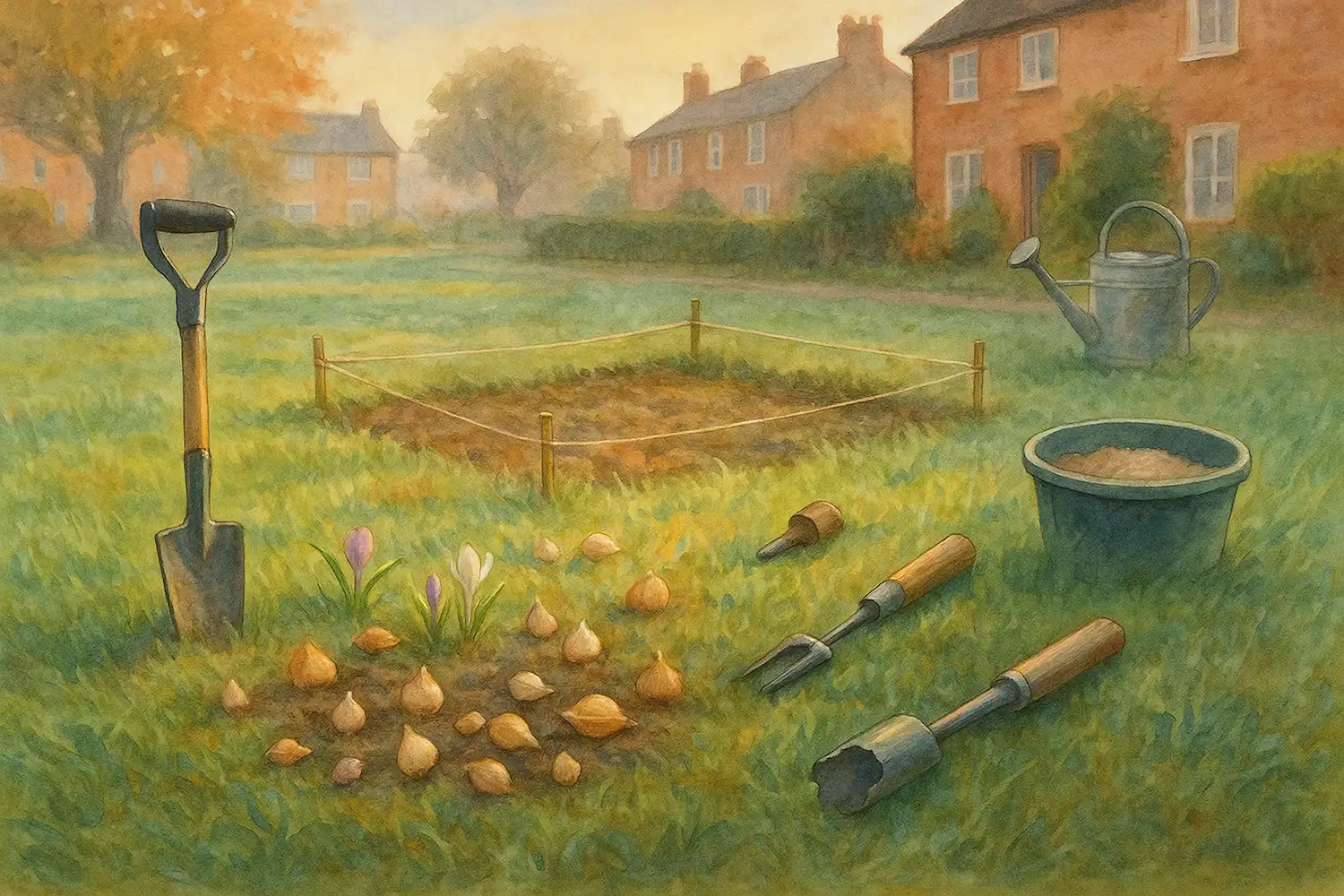
Learning how to naturalise bulbs in grass can feel a bit daunting, but it’s a straightforward process for UK lawns. This guide will walk you through the simple steps; from scattering your bulbs and planting them correctly to knowing exactly when to start mowing. You’ll learn how to create that stunning, natural meadow look without the hassle, all based on my own experience with wet soil and a no-mow patch.
Zone 8a, small lawn friendly. Written for real UK conditions: clay, rain, and the neighbour who loves a tidy verge.
Scatter bulbs where they fall, plant at roughly three times their height, then wait six weeks before mowing.
- Depth: About 3× the bulb’s height.
- Aftercare: Don’t mow for six weeks after flowering.
- Mowing: Start high, then lower gradually over a few cuts.
Why naturalising bulbs in grass is a good idea? (beauty, wildlife and timing)
Naturalising bulbs in grass transforms a plain lawn into a stunning seasonal meadow. It’s an easy way to add early spring beauty, support wildlife, and take advantage of natural timing. If you’ve been looking for a method that works for damp, heavier UK soils, this is the guide for you.
- Beauty: Turns a plain lawn into a seasonal meadow.
- Wildlife: Crocus and snowdrops provide early food for bees.
- Timing: Bulbs are active before the grass, giving them space to thrive.
The best planting window in the UK is September to October, before the ground freezes. Early bulbs get a head start, and the winter light reaches them before the grass begins its spring sprint. That breathing space is your best friend.
If you’ve had trouble before with bald patches or mowing too early, this guide focuses on practical fixes for real UK conditions. We’ll show you how to keep the turf intact, improve drainage in each hole, and set a mowing schedule that will help your bulbs return stronger year after year.
Plan your no mow zone (site selection, size and bulb choice)
SStart by deciding where you can happily pause mowing for at least six weeks in spring. A front garden verge, a corner of a back lawn, or a defined strip along a path all work well. Aim for areas with good winter and early spring light and reasonable drainage. Heavy clay is not a deal-breaker—you can easily fix each planting hole with a sprinkle of grit or spent compost.
Once you have a spot, match bulbs to your space and the height of the grass:
- Crocus & Snowdrops: Perfect for February to March sparkle in short grass.
- Miniature Daffodils (Narcissus): A great choice for March to April staying power.
- Fritillaries (Snake’s Head): Ideal for wilder, slightly damper lawns.
- Camassia: Plant these for a later, taller bloom in a larger patch.
- Scillas & Grape Hyacinths (Muscari): These create low, early carpets that knit well between other bulbs.
For the best look, keep your palette tight with two or three species. You can scatter more each autumn to build up a denser, more natural display over the years.
Planting step by step: scatter, cut, add grit and replace
Naturalising bulbs in your lawn is an easy and enjoyable process. Here is a quick primer on the tools you can use to get the job done quickly and neatly.
- Tools Primer: A long-handled bulb planter speeds up planting larger bulbs like daffodils. A metal post or slim dibber is perfect for crocus and snowdrops in looser soil. A plug cutter gives you surgical plugs in very tight turf. None of these are mandatory; they just help keep things neat and quick.
Before you start, here is a 30-second checklist:
- Mark a 1 to 2 m² no-mow area.
- Lay out bulbs, your chosen planter, grit, and a watering can.
- Set a phone reminder for the earliest safe mow date.
Now, let’s begin. Work bulb by bulb:
- Begin with a Random Scatter. Gently toss the bulbs over your marked no-mow zone. Resist the urge to arrange them—the goal is to create natural, irregular drifts.
- Cut the Plug. Using your bulb planter or cutter, twist out a core of turf and soil. Aim for a depth of roughly three times the bulb’s height. For very tight turf, you can use the Kew turf flap method by slicing three sides of a small square and peeling back the turf.
- Improve the Hole. Drop a small handful of grit or a mix of grit and spent compost into the hole. This is especially important for heavy clay soil as it improves drainage.
- Place the Bulb. Place the bulb in the hole with the pointy end facing up. If you’re unsure which way is up, lay it on its side—it will find its way.
- Replace and Firm. Return the plug or turf flap to its original spot. Heel it in so the surface sits flush with the rest of the lawn. Water if the ground is dry.

Your Bulb Planting Questions Answered
Do I need a bulb planter to plant in grass?
You don’t need a bulb planter for naturalizing bulbs in your lawn, but it can be very helpful. A long-handled bulb planter is fast and tidy for larger bulbs like daffodils. For smaller bulbs in looser soil, a metal post or dibber works well. For tight turf, a plug cutter or the Kew turf flap method will keep the surface neat and help your lawn heal without bald spots.
How deep should you plant bulbs in grass?
A good rule of thumb is to plant bulbs about three times the bulb’s height, as recommended by the RHS. This is about 5 to 8 cm for small bulbs like crocus, and about 10 to 15 cm for larger bulbs like daffodils.
- Depth: Plant at about three times the bulb’s height.
- Spacing: Don’t measure; space them by eye. Crocus and snowdrops look best planted about 7 to 10 cm apart.
- Grouping: For small bulbs, plant in groups of three to seven rather than singles to create a natural, clumping look.
- Grit: On heavy clay soil, a small handful of grit in each hole will help improve drainage and prevent bulbs from rotting.
- Firming: Firm the turf back so the plug is flush with the ground. This also hides scent trails that can attract squirrels.
Implementation intention: This weekend I will scatter and plant at three times depth, add a pinch of grit to each hole, and leave the area unmown until the leaves yellow.
Aftercare and Mowing: A Simple Guide
The single most important rule after planting is to respect the six-week no-mow window in spring. Let the bulb’s leaves photosynthesize and turn yellow naturally; that’s your cue the bulb has recharged and is ready to be cut.
When and How to Mow
When the leaves have yellowed, which is typically about six weeks after flowering, you can begin to mow.
- First Cut: Set the mower to its highest setting, around 6 to 7 cm.
- Next Cuts: Over the following weeks, gradually reduce the height to your usual lawn setting of about 4 cm.
- Pro-Tip: Always keep the blade sharp and never remove more than one-third of the leaf in a single mow. This prevents shocking the grass and helps the lawn stay healthy.
Feeding and Weed Control
- Fertiliser: Avoid using a general lawn fertilizer. This will mostly feed the grass, which will then outcompete your bulbs. Unless your soil is very poor, it’s best to skip feeding entirely.
- Weeding: Keep weeds down by hand while the leaves are soft. Resist the urge to tie or knot the foliage of your bulbs, as this can prevent them from getting the light they need to recharge.
If you have planted later-blooming varieties like Camassia or Fritillaries, be prepared to delay your mowing until June. The payoff is a longer meadow moment in your garden.

Pests and protection, quick fixes
When you plant bulbs, pests like squirrels, birds, and slugs can sometimes be a problem. Fortunately, there are some simple steps you can take to protect your newly planted bulbs and soft spring growth.
- For Squirrels and Birds: After planting, make sure to return the turf plug so it is flush and firm. This removes scent trails and loose soil that invites digging. If they are still a problem, peg down a temporary mesh over the patch until the bulbs start to grow.
- For Slugs: For slugs on new crocus or fritillary growth, hand-pick them after dusk or use wildlife-friendly ferric phosphate pellets sparingly.
Mini 6 week mow planner, guide
| Flowering month, typical | Bulb species, examples | Earliest safe mow, leaves usually yellow by |
|---|---|---|
| Feb to Mar | Snowdrops, early crocus | Late Apr to early May |
| Mar to Apr | Crocus, miniature daffodils | Mid to late May |
| Apr to May | Daffodils, later forms, fritillaries | Late May to early Jun |
| May to early Jun | Camassia | Late Jun to early Jul |
Always use the leaves as the real signal. Yellowing beats dates.
FAQs: fixes for common problems, patchy growth, heavy soil, early mowing
Which bulbs suit lawns best? Crocus and snowdrops are great for early sparkle. Miniature daffodils are reliable, while fritillaries work well for a wilder patch.
Will bulbs spread in a lawn? Yes. Snowdrops, scillas, and Muscari self-seed gently. Daffodils divide over time. You can top up the patch with a small scatter each autumn to build density.
Can you naturalise tulips in grass? Botanical tulips cope best, but many tall tulips will not naturalise well and are better suited for borders or pots.
What does “in the green” mean, and should I do it? It means planting bulbs while their leaves are still green in late winter. This is a great method for snowdrops.
What if my soil is heavy clay? Use the plug and grit approach every time. Peel back a turf flap, loosen the soil, add grit, and then replace the turf.
Do I need fertiliser? No. Bulbs store their own food. General fertilisers mostly feed the grass, which then outcompetes the bulbs.
How deep should I plant bulbs in grass? Plant at about three times the bulb’s height (5 to 8 cm for small bulbs, 10 to 15 cm for large bulbs).
How soon can I mow? Wait six weeks after flowering or until the leaves naturally turn yellow. When you do mow, start high and reduce gradually.
Do I need a bulb planter to plant in grass? No. While a planter is tidy for larger bulbs, a simple metal post or a plug cutter works just as well.
Can I plant bulbs in a frequently mown lawn? Yes, if you can commit to a no-mow zone for six weeks in spring.
Which bulbs suit lawns best?
Crocus and snowdrops for early sparkle. Miniature daffodils for reliability. Fritillaries for a wilder, damper patch. Camassia if you can wait longer to mow. Tall tulips are less lawn friendly and do not naturalise as well.
Will bulbs spread in a lawn?
Yes. Snowdrops, scillas and Muscari clump and self seed gently. Daffodils divide slowly over time. Top up with a small scatter each autumn to build density.
Can you naturalise tulips in grass?
Botanical tulips cope best, but many tall tulips fade after a year or two. You will usually get better repeat shows in borders or pots.
What does “in the green” mean, and should I do it?
It means planting certain bulbs while their leaves are still green and active, usually in late winter or early spring. Snowdrops establish well this way. Plant small clumps where you want them, keep them watered, and do not mow until the leaves yellow.
What if my soil is heavy clay?
Use the plug and grit approach every time. Where turf is very tight, use the Kew method. Peel back a small turf flap, loosen the soil, add grit, set the bulb, then lay the turf back. In waterlogged spots, pick another area or improve drainage first.
Do I need fertiliser?
No. Bulbs store their own food. General fertilisers mostly push grass growth. If your soil tests poor in potassium, a light dusting of potash in spring is enough.
How deep should I plant bulbs in grass?
Roughly three times the bulb’s height. That is about 5 to 8 cm for small bulbs such as crocus, snowdrops, scillas, and Muscari, and about 10 to 15 cm for daffodils and camassia.
How soon can I mow?
Wait six weeks after flowering or until leaves naturally yellow. Start high, then step down over a couple of cuts so you do not scalp soft regrowth.
Do I need a bulb planter to plant in grass?
No. It just makes neat, repeatable holes for bigger bulbs. A metal post or dibber works for small bulbs. In tight turf use a plug cutter or peel a small turf flap, the Kew method.
Can I plant bulbs in a frequently mown lawn?
Yes, if you can hold a defined no mow strip or patch for six weeks. Otherwise, use a border or container and keep the main lawn neat.
Bulb count helper, rough guide by area
Use this as a starting point. Go denser at the front and looser at the edges so it looks natural.
| Lawn area | Crocus and snowdrops, 7 to 10 cm apart | Mini daffodils, 10 to 15 cm | Camassia, 20 to 25 cm |
|---|---|---|---|
| 1 m² | 100 to 150 | 40 to 80 | 15 to 20 |
| 2 m² | 200 to 300 | 80 to 160 | 30 to 40 |
| 5 m² | 500 to 750 | 200 to 400 | 75 to 100 |
Tip: keep a little bag back for gaps you notice after rain. Topping up is how meadows happen.
You must be logged in to post a comment.