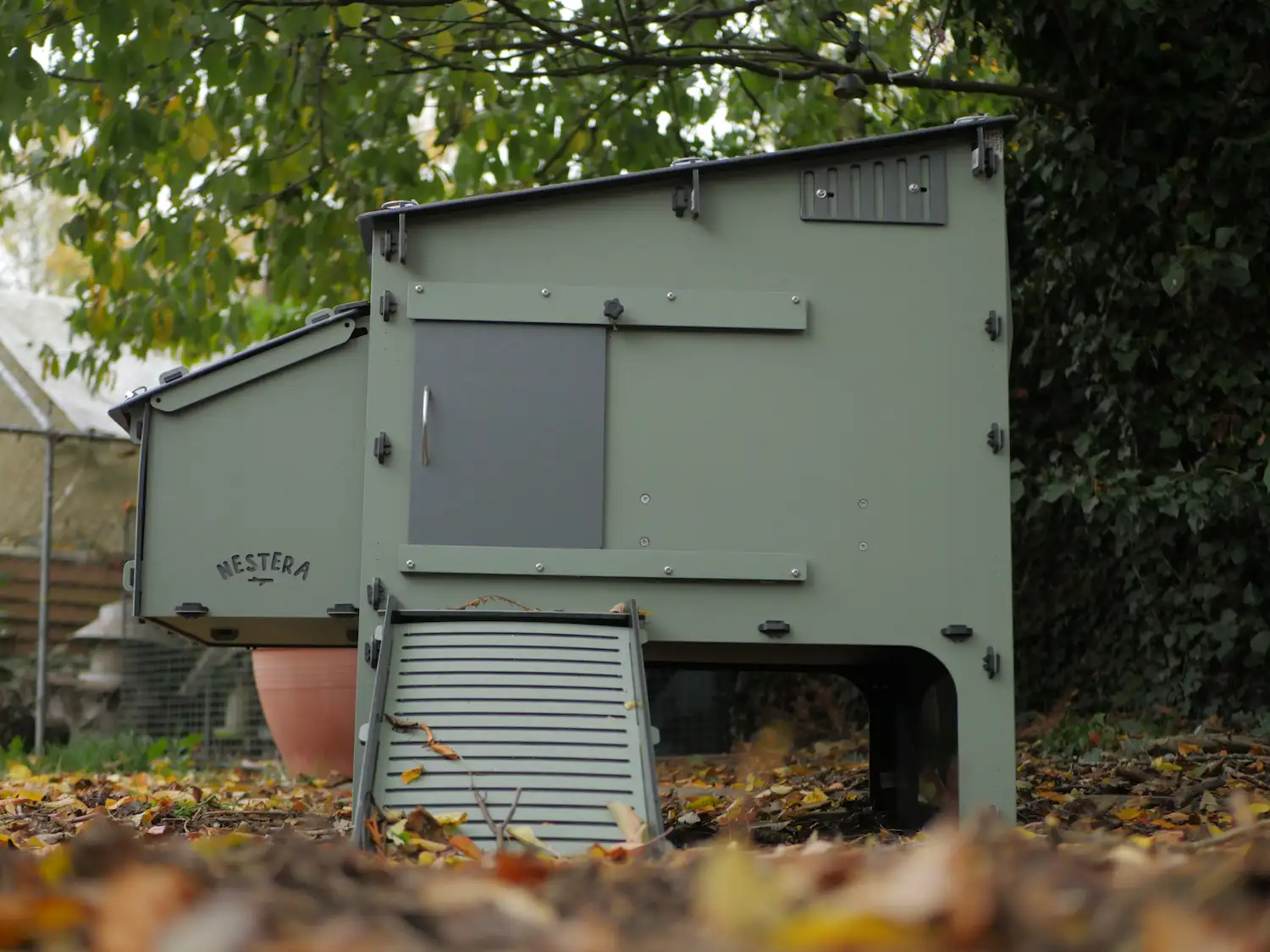
On a wet cleaning day, the difference between scraping damp timber and sliding out a washable tray feels less like a product feature and more like a small gift. Nestera sent me the Aspen 6 in 2025, after I had already lived with bought, homemade and Nestera Penthouse coops. Extended use has confirmed its best quality—easy access—but has also produced a more useful verdict on red mites, durability and the considerable faff of moving it.
At a glance
- Best choice if: You want wide cleaning access, washable surfaces and a coop that can remain in one place.
- Skip this if: You regularly move your hens around the garden.
- Manufacturer-stated capacity: Six medium-sized hens. Use the coop and run size calculator to assess your own flock.
- Extra to price: Our setup has droppings trays, but Nestera listed them as an optional add-on in November 2026.
- Long-term finding: The coop still looks close to new after cleaning, although we have now had—and managed—red mites.
What we tested and the current Aspen 6 specifications
This review covers the Aspen 6 shown in my photographs and video, not the larger Aspen 10. Nestera sent it to me after I had already bought and used one of its Penthouse coops, so I came to the Aspen with a fair idea of what I liked about the company’s plastic design—and what I wanted the newer model to improve.
The Nestera product page, checked on 26 November 2026, lists these specifications for the Aspen 6:
| Stated capacity | Six medium-sized hens |
| Panel construction | 7 mm panels made from 70% recycled plastic |
| Included interior | Two perches and two nest boxes |
| Ground clearance | 27 cm |
| Warranty | 10 years |
| Droppings trays | Present in our review setup, but listed separately as an add-on on the current retail page |
That six-hen figure is Nestera’s stated capacity, not a promise that six birds of every breed will fit comfortably. A flock of compact, active hybrids is a different proposition from six broad, heavily feathered birds. Perch space, bird size, mobility, run size and how long the hens spend inside all matter, so use the headline number as a starting point rather than the whole calculation.

The useful details are the removable perches, nest-box divider and generous rear access. The joints on ours fitted snugly when I assembled it, and the pre-cut door opening can accept Nestera’s Smart Auto Door. The sage-green roof and dark sides also look tidier in the garden than many plastic houses, although the hens remain magnificently indifferent to colour schemes.
How easy is the Aspen 6 to clean?
Cleaning access remains the Aspen’s strongest feature. Our routine clean takes about 10 minutes of hands-on work: I remove the bedding and loose material, take out the trays and perches, wash the surfaces I can reach, then put the interior back together once it has drained and dried as conditions require.
- Open the rear panel to reach the perches, floor and trays.
- Remove the bedding, trays and perches. The trays make loose material easier to carry away, but check whether they are included in the package you are pricing.
- Wash the accessible surfaces, allow the parts to drain and dry, then add clean bedding and reassemble the interior.
Where red-mite treatment forms part of our routine, I apply it according to its instructions. Application and treatment contact time are separate from that 10-minute cleaning figure.

A deep clean is a different job
For a genuine deep clean, I take panels apart to reach the corners and joints that the routine wash cannot clear properly. I have not timed that job, so the 10-minute result should not be mistaken for a complete strip-down. It is a quick weekly-style reset, not a poultry-house pit stop worthy of Formula One.
It is still far less awkward than cleaning the wooden coops we owned, one bought online and one built ourselves. Those involved more scraping, more attention to joints and a longer wait for damp boards to dry. If you are weighing those routes, my broader Nestera versus cheap wooden coop comparison covers the trade-offs without pretending that either material removes routine maintenance.
Ventilation and weather performance
The Aspen has adjustable vents on its sidewalls. After another year of use in the East of England, I have not found recurring condensation. The panels show no noticeable wear, the latches still feel like new and, once cleaned, the house looks remarkably close to the day I assembled it.
That is a useful long-term observation, but it is not a promise of all-season comfort in every garden. I have not measured the coop’s insulation performance, and a house being close to the outdoor temperature would not by itself tell us whether the birds are comfortable. Position, stocking, bedding, wind exposure and the keeper’s vent settings all change the result.

The Code of practice for the welfare of laying hens and pullets applies to hobby and backyard flocks in England. It calls for ventilation and insulation that avoid heat and cold stress, with conditions monitored through the seasons. If you can smell ammonia, the code says it is likely to be too high and action is required. Prolonged huddling in the warmest part of the house can also indicate that the flock is not comfortable over the longer term.
Watch the coop and the hens rather than treating one vent position as correct forever. Check for condensation, damp bedding, persistent odour and changes in where or how the birds settle. My guide to chicken-coop ventilation during damp UK winters explains that seasonal adjustment in more detail.
Does a plastic coop prevent red mites?
No. When I first reviewed the Aspen in 2025, my after-dark torch checks had found no red mites. We have since had them. Cleaning and treatment have made them manageable, but their arrival puts a firm boundary around the familiar claim that a plastic coop is “mite resistant”. Easier to inspect and clean? In my experience, yes. Mite-proof? Absolutely not.
The smooth panels and removable parts make the job less miserable, but mites can still occupy joints, corners and fittings—the very places I concentrate on during a deep clean. Plastic should be treated as helpful access for monitoring and cleaning, not as a remedy in its own right.
The government code warns that the red-mite lifecycle can be as short as a week. It recommends routine checks of equipment, furnishings and birds, with a monitoring and treatment protocol devised with a veterinary surgeon; mite traps can also help monitor activity. If mites persist, or birds develop pale combs, weakness, reduced laying or other signs of illness, seek veterinary advice rather than relying on repeated washing alone.
Assembly, daily use and security
I assembled our Aspen alone in about 45 minutes, including unpacking. The pictorial instructions were straightforward, and the plastic pins and basic fittings needed only ordinary hand tools. That is my time for this particular build rather than a promised result, but there were no moments when the instruction sheet appeared to be describing an entirely different object—a modest triumph in flat-pack terms.
Daily use is simple. The main door slides vertically and latches at night, while the nest-box roof lifts for egg collection. The latch still operates as it did when new. Once positioned, the house feels reassuringly stable; unfortunately, that same solidity makes it a nuisance to drag around the lawn. For a rotational setup, this may outweigh the cleaning advantage.
Nestera markets its reinforced latch as predator protection, but I have not independently tested the Aspen as a fox-proof system. Security depends on the whole setup: run, ground perimeter, anchoring, doors and the nightly closing routine. Assess all of those rather than relying on the coop shell alone.
Price, value and alternatives
On 26 November 2026, Nestera listed the Aspen 6 at £575 plus £25 shipping, while a Black Friday promotion was running. Treat that as a dated snapshot. Check the current basket price and package contents, particularly if you want droppings trays, a run or an automatic door.
This is a premium purchase beside a basic wooden house. Its value is not in a guessed lifespan but in whether the access and washable surfaces save you enough work to justify the outlay. They do for me. The 10-year manufacturer warranty is reassuring, although no warranty means that every part will remain pristine for a decade.
I have also used Nestera’s Penthouse. Its higher working position may suit someone who dislikes bending, while the Aspen has a lower, more compact arrangement. Neither is something I would buy with the intention of casually moving it every few days.

I have not tested a current Omlet model alongside this Aspen, so I cannot give a fair model-for-model verdict. If Omlet is on your shortlist, compare a named current configuration—including its run and accessories—with the complete Aspen setup you would actually order.
Aspen 6 FAQs
How many hens does the Aspen 6 hold?
Are droppings trays included?
Can the Aspen 6 use an automatic door?
Is the Nestera Aspen fox proof?
Who is the Aspen 6 right for?
The Aspen 6 suits a keeper who wants a fixed plastic house with wide access and removable parts. Ours remains in excellent condition, and the routine clean is short enough that it gets done before the job has time to become a looming weekend project. That matters more in daily ownership than almost any line on a specification sheet.
Its limits are equally clear now. It is awkward to reposition, extras can push up the price, and red mites still require proper monitoring and treatment. If those conditions work for you, measure the permanent position, price the complete package and use the coop and run size calculator before ordering. I would buy it for easy access and washable construction—not because plastic promises a maintenance-free life, because chickens have yet to invent one of those.

You must be logged in to post a comment.